

Miguel is 35. He lives in Spain. He studied law and politics, not engineering. He runs a construction company that does about €20 million a year with 50 direct employees and around 300 contractors. He has not hired a single developer. He has shipped a full web app — plus native iOS and Android apps — from a single React Native (Expo) codebase that runs his entire construction company. He built every line of it himself in Rork.
This is a case study of what happens when a non-technical CEO of a mid-market construction company stops shopping for construction management software and starts building it.
I have ideas in my head I could never build. Now I can. This is amazing for me. I have like 100 apps in process.
Miguel's company is Grupo Tecnon (@grupotecnonsl), based in Almería, Spain. For over 20 years they have specialized in single-family homes and industrial construction, as well as renovations — constantly striving to stay up to date so they can offer the best service possible.
"That is why Rork acts as a partner that has enabled us to incorporate all the latest updates into our projects through our software."
How one Rork app replaced his entire construction SaaS stack
For fifteen years Miguel ran the construction business on the standard mid-market mess: Microsoft tooling for budgets, spreadsheets for project tracking, email threads for client intake, and a small herd of SaaS subscriptions that did not quite fit construction. None of it talked to each other. None of it modeled his actual workflow.
He evaluated the vertical players, Procore, Buildertrend, JobTread, and the Spanish ERP options (Sage Construction, Fixner, Holded). Each quote was either six figures upfront or per-seat pricing that punishes a 50-person field-heavy business. None of them modeled his subcontractor structure. The classic mid-market construction software gap, where the off-the-shelf vendors optimize for the ends and skip the middle.
The agency path doesn't pencil out either. Industry pricing guides put a custom ERP build for a mid-market company in the $50,000 to $150,000+ range to develop, plus 15–25% of that every year in ongoing maintenance and support that never stops. The kind of math that kills a project before it starts.
Miguel found Rork on TikTok. He's been a user since the early days. He has tested Codex and Claude, and openly admits he could probably pay less elsewhere. He stays with Rork for the support, the pace at which the product improves, and the confidence that whatever he sets out to build, Rork can ship it. (See how Rork stacks up against the other AI builders like Lovable and Replit for shipping real mobile and web apps.)
The construction company app he built
One Rork project, three platforms. The core of the whole system is a full web app his office runs the entire business on — and the same codebase ships the native iOS and Android apps his technicians use in the field. Rork is best known for mobile, but here it generated a production web app too, from the same project. He works on it in the evenings, planning each feature with ChatGPT, then building with Rork's plan mode.
Call it what it is: a business app. Not a consumer app chasing downloads, not a generic SaaS tool bent to fit — a single app that runs a whole company's operations, built by the person who runs the company. This is the category most small and mid-sized businesses never had access to, because building one meant hiring developers. An SMB business app is software shaped around exactly how one business works, owned outright by the operator. Miguel's is a construction one; the same pattern fits a dental practice, a law firm, a logistics outfit, or a restaurant group.
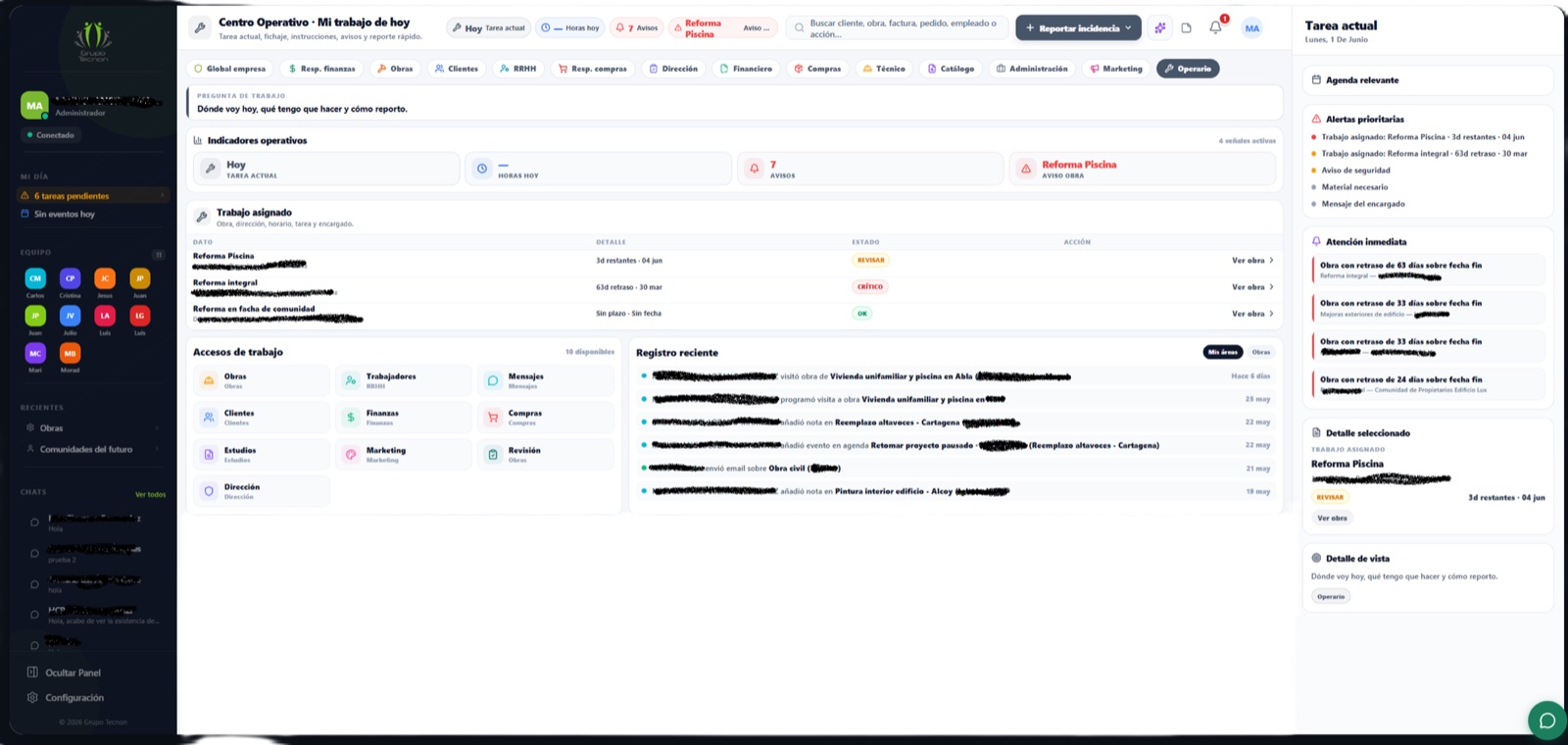
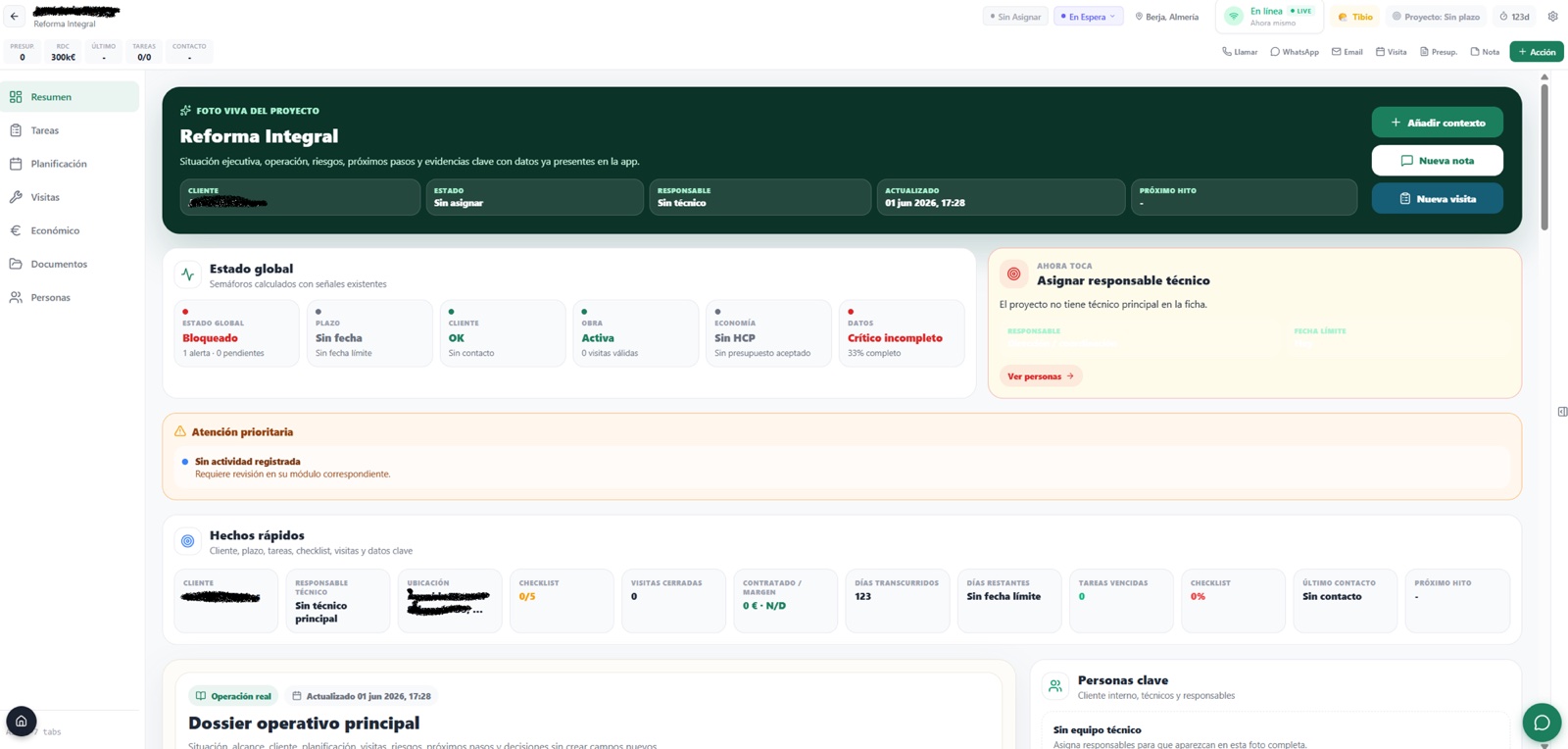
This is what the construction ERP software actually does:
Client lifecycle and CRM, end to end. New leads land in the system from anywhere. Anyone in the company can add a client. A kanban pipeline (To Call → Awaiting Technician → Budgeting → Budget Sent → In Construction) shows where every job is right now. Miguel gets a push notification within seconds of every new lead. Nothing falls through email cracks. This replaced the kind of per-seat construction CRM software that Salesforce Sales Cloud Enterprise bills at $175 per user per month. See Salesforce alternative for SMB construction.
Field service mobile app for technicians. Technicians visit sites with a phone. They tap once to mark that they've arrived. They record a voice note describing what they saw. They snap photos. OpenAI transcribes the voice, analyzes the transcript and the photos, and writes a structured site report directly into the client record. Work that used to tie up a lot of back-office people now runs itself. See how to build a field service mobile app with voice notes and AI reports.
Auto-generated contracts with e-signature. When a budget gets approved, one button generates the full contract: Miguel's clauses, the budget terms, the provider details. A signing link goes to the counterparty. They tap. They sign. The signed PDF returns to the file. Provider onboarding that used to take days closes in a button click. See how to auto-generate contracts with e-signature in your business app.
Real-time operations dashboard. Who's on the clock right now, and an activity view that shows the team is actually working in the system (something he vetted himself as a lawyer to keep within the rules). Cash flow. Provider payables. Invoices waiting to go out, invoices waiting to come in. Operations visibility that vertical SaaS like Procore charges enterprise pricing for.
Miguel, that's pretty amazing. I'm doing all my work very fast.
And then he built three more apps
Once the construction company app shipped, the constraint of "I need to hire a developer to build software" was gone. The personal apps he built next show what compounds:
- A home finance app for him and his wife, replacing the kind of budgeting subscription that apps like Monarch and YNAB charge around $15 a month (~$100+ a year) for.
- A 7-a-side football prediction app for him and his friends, shipped to the App Store and Google Play. About 100 users in a week and a half on a freemium model (some on the paid tier), zero marketing, all from his existing network.
- A mindfulness app for the people around him.
None of these are businesses. They are tools that did not exist before because hiring a developer was the wall. The wall is gone.
The ChatGPT plus Rork workflow
The operator workflow Miguel runs is the same workflow real SMB owners shipping software in 2026 converge on:
- ChatGPT to think. He dumps the business problem into ChatGPT. The model interrogates him on edge cases. He comes out with a long, structured product spec. ChatGPT now formats specs in a way Rork ingests cleanly.
- Rork in plan mode. He pastes the spec into Rork's plan mode. Plan mode asks him the questions he didn't think to answer, surfacing the gaps and edge cases he'd skipped over. He answers. The spec hardens.
- Build. Rork generates the Expo project. He iterates in conversation, screenshots what's wrong, refines.
- Ship. Builds for App Store and Google Play go out from his local VS Code project. Web target deploys to Render.
Supabase holds all the data. He owns the database. He owns the Expo codebase. He owns the App Store accounts. There is no vendor lock-in. If he ever walked away from Rork, the apps keep building from the code he owns.
Full breakdown: the ChatGPT plus Rork workflow for non-technical operators.
How the Rork app cut his operational costs
Miguel does not talk about MRR. He talks about cost not paid and time not spent. The operational cost optimization from running on a custom ERP software instead of a SaaS stack:
- No more SaaS licenses for the workflows the app replaced — starting with the budgeting software his team ran on for years. All of it now lives inside the one app he built.
- No agency retainer. Commissioning a custom build at this scale would have meant six figures up front plus 15–25% of that every year in maintenance and support — an open-ended bill he never had to take on.
- No developers hired. No salaries to pay, no team to manage, no bus factor risk.
- No information loss in client intake. Before the app, a new client arriving via phone meant someone had to remember to write it down and tell someone else. Now every lead is captured automatically and a record exists permanently. Lost leads stopped being a category.
- Provider contracts in one click. Days of back and forth, gone.
- Faster back office. His finance director's verdict, a day in: he's getting all his work done fast.
He won't put a number on the total saving — he says he genuinely doesn't know exactly. He doesn't have to. The math is obvious every month.
The same playbook, rebuilt for other industries
The construction ERP was the proof. Now Miguel is taking the architecture he already owns and reshaping it for businesses outside his own. He's developing and testing adapted versions of his apps with a property management company, and another set for sports clubs, each one rebuilt around that profession's real workflow rather than bent to fit generic software. His read on the opportunity is blunt: there are a lot of markets sitting on very expensive software that's wide open to something newer, more elaborate, and closer to what the professionals in them actually need. Construction was just the first one he knew well enough to start with.
Why this case study matters for SMB construction owners
There are tens of thousands of mid-market construction companies, services businesses, dental practices, logistics operations, and retail chains run by smart, non-technical operators sitting on years of operational knowledge that no construction SaaS vendor is going to package for them. They have been told the only way to get custom construction software is to either hire engineers they can't afford to manage or pay an agency more than the software will ever save. Both options have been the ceiling on what their business can become.
Miguel skipped both options. He used Rork to build the construction company ERP software he had been carrying in his head for years.
If that sounds like you, if you have been quoted a number you couldn't stomach, if there is a workflow you have been carrying for years that nobody else will build for you, you're in good company. Miguel built his. So can you.
This is the era of personal business software. Off-the-shelf SaaS was the era when software shaped your business. Custom, owner-built software is the era when your business shapes the software. Rork is the AI app builder that opened this era for SMB operators who never had the leverage before.
See the related operator guides:
- How to build a mobile app for your construction company
- How to build a field service mobile app with voice notes and AI reports
- Build a mobile CRM your team will actually use
- What a custom mobile app actually costs for your business in 2026
- Procore vs Buildertrend vs custom: what a $20M construction company should pick
- Custom software quote vs operator-built app: the $200k vs $5k breakdown
- How to build your own ERP in 2026 when SAP and NetSuite are overkill
Frequently asked questions
Can a non-technical construction company owner really build a custom ERP software? Yes. Miguel is the proof. He studied law and politics, not computer science. He runs a €20M construction company. He used Rork to generate the iOS, Android, and web app, Supabase to store the data, and ChatGPT to plan each feature. No engineering background was required. For a deeper assessment of what is and is not in reach for non-technical operators in 2026, see can a non-technical owner actually ship a real mobile app in 2026.
Can Rork build web apps, or is it only for mobile? Both. Rork is best known for mobile, but the same project ships a real web app too. For Miguel the web app is the core his office runs the entire business on, with the native iOS and Android apps as the field companion for technicians. One Expo codebase, deployed to the web and to both app stores.
How long does it take to build a construction company app like this? A working v1 with client pipeline and mobile field app takes 30 to 60 days of evening work for most operators. Adding the AI voice-to-report flow and one-click contract e-signature adds another 30 to 60 days. Miguel's full system grew over thousands of hours of evening work since day one, and he's still building on it.
What does it cost compared to Procore, Buildertrend, or Salesforce? Procore typically prices at $375 or more per seat per month for a mid-market construction company, scaling to $50,000 to $100,000 per year for a 50-person team. Salesforce Sales Cloud plus Field Service Lightning is $144,000 or more per year at the same scale. A custom Rork-built construction ERP software runs around $5,000 per year all in (subscription plus Supabase plus cloud infra). See the full cost breakdown.
Does the custom app work outside Spain? Yes. The exact same architecture works for construction companies in the US, UK, Australia, Brazil, Mexico, France, Germany, and anywhere else construction operates. The only piece that changes per country is e-invoicing compliance (Spanish SII, German XRechnung, Brazilian NF-e, US standards), which integrates via Supabase Edge Functions.
Does this work for verticals other than construction? Yes. The same operator-built ERP pattern is being used by dental practices, real estate investment firms, B2B wholesale distributors, cannabis dispensaries, emergency response teams, and other SMB verticals. See the full set of vertical guides.
What happens if I cancel my Rork subscription? Your apps keep working. You own the Expo project, the source code, the Supabase database, and the App Store accounts. Rork generates standard portable code. There is no vendor lock-in.