All SMB· Comparison

The Best AI Builder for Android Apps in 2026: Rork vs Lovable, Replit & Base44

The Android question isn't which AI builder can make something that opens on a phone. It's which one ships a first-class native Android app. Here's how Rork, Replit, Lovable, and Base44 actually compare — and why the answer depends on whether you're building an app or a website with an icon.

For Android, the real test isn't whether the screen renders. It's whether the app behaves like a first-class Android product: fast startup, smooth scrolling, responsive gestures, low battery use, proper device APIs, Material-style UI behavior, and a codebase that can keep growing as Android itself evolves. Those are Android's own performance priorities — users expect apps to launch quickly, render smoothly, and respect memory and battery.

That bar is exactly why most AI app builders fall short on Android. Lovable and Base44 produce web apps. Replit produces React Native. Only a small number of AI builders generate real native Android — Kotlin + Jetpack Compose — and Rork is one of them.

Rork is, as of mid-2026, one of the only AI app builders generating real native code for both iOS (Swift) and Android (Kotlin + Jetpack Compose) from a single prompt-first workflow. Rork Max ships native Swift. Rork Pro ships native Kotlin + Compose for Android, plus Expo / React Native and web from the same codebase. Most "AI mobile" tools force you to pick one of those tradeoffs. Rork lets you pick the right one for what you're building.

This guide is Android-only. Web and iOS are out of scope. The question is: which builder actually ships an Android app — not a website wrapped in an icon?

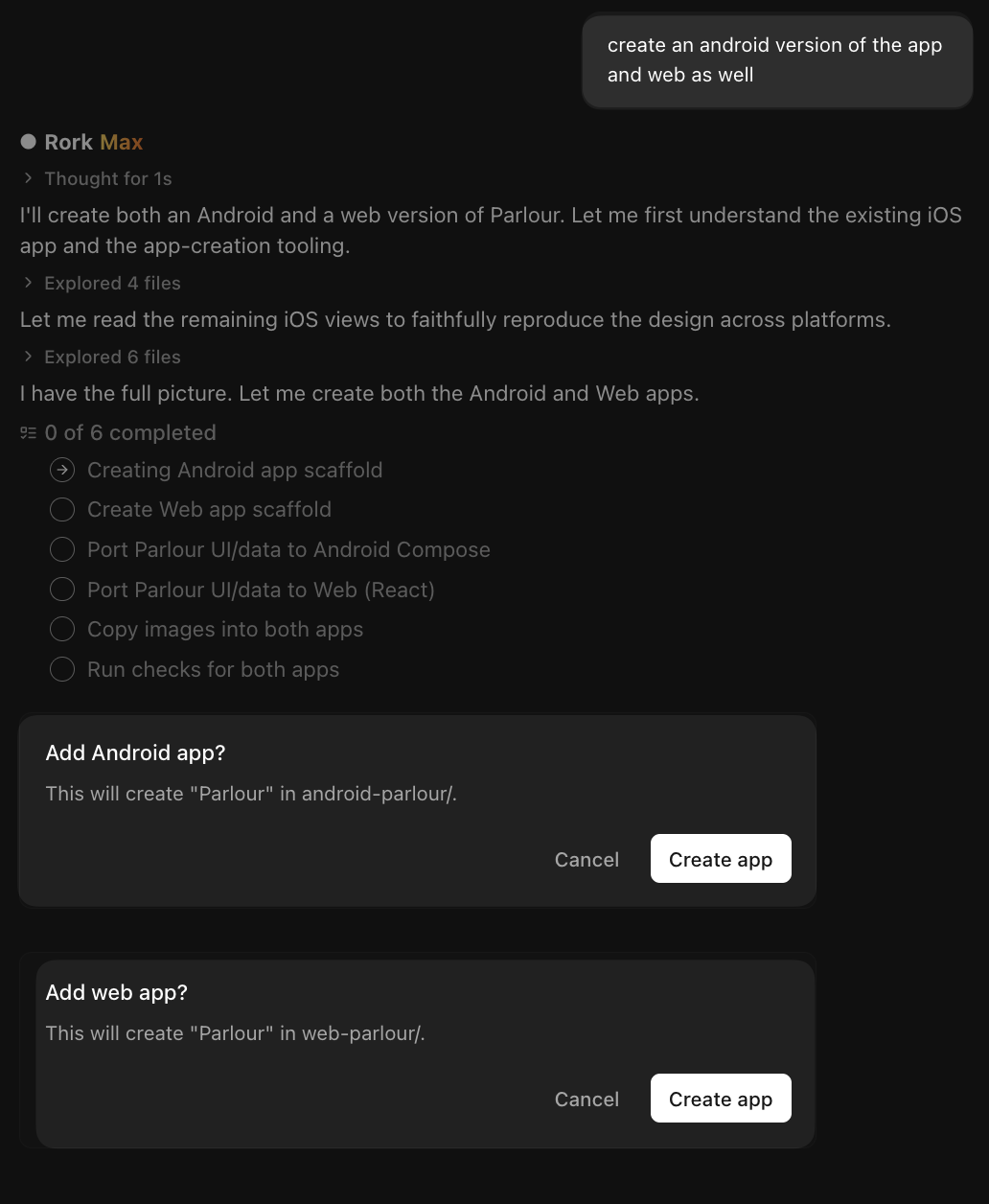
Rork generating a native Android version and a web app from a single project — Kotlin + Compose scaffold, not a wrapper

Why Kotlin + Compose Changes the Comparison

Kotlin and Jetpack Compose aren't just developer preferences. They're the center of modern Android development. Android is Compose-first, and Compose is Google's recommended modern toolkit for native Android UI: native performance, adaptive layouts, animation APIs, Material 3 components.

That gives Rork's Android path a structural advantage. It isn't generating a mobile-looking interface and hoping Android accepts it. It's generating an Android app on Android's own native stack.

This matters most when the app gets ambitious. A simple CRUD tool may feel acceptable in any builder. But once an app needs camera flows, background work, offline behavior, push notifications, maps, Bluetooth, sensors, media, payments, widgets, or performance-sensitive UI, the underlying architecture is the product. Kotlin + Compose gives Rork-built Android apps a direct path into the Android platform instead of forcing every feature through a cross-platform layer or a WebView.

Rork vs Replit: Native Android vs React Native / Expo

Replit is the closest competitor — it generates mobile apps, but the mobile workflow runs on React Native and Expo. Preview in an Android Emulator, test through Expo Go, build cross-platform from a shared codebase. Useful for prototypes and cross-platform apps. Different architectural bet.

React Native is a real framework, much closer to native than a WebView wrapper. It aims for native look and feel and 60 FPS, but React Native's own docs acknowledge that performance work is sometimes manual. Expo adds convenience, but Expo Go has limits — native libraries outside the included SDK require custom development builds, and many native capabilities mean stepping outside the default Expo Go flow.

Rork's Kotlin + Compose mode avoids that mismatch entirely. Instead of starting in TypeScript and reaching into Android through React Native modules, it starts where Android already lives: Kotlin, Compose, Android APIs, Android build conventions, Android performance tooling.

For builders choosing an Android solution specifically — not a general-purpose coding sandbox — that distinction is decisive. Replit is broad across all kinds of code (Python, Node, scripts, learning environments, backends). Rork is focused: it ships production-grade mobile and web apps, and its Android mode is Android-native.

(Worth noting: Rork Pro also ships an Expo / React Native path for builders who want cross-platform from one codebase. You don't have to choose the platform-native route. But when you do, Rork delivers actual Kotlin — Replit's mobile workflow doesn't go there.)

Rork vs Lovable: Native App vs Web App

Lovable produces web apps. That's the entire output — internal tools, dashboards, landing pages, SaaS frontends, deployed to a URL.

Rork also produces web apps, and can build a web app side-by-side with a native Android version from the same workspace. That's the difference: Rork's web output isn't the only output. Lovable's is.

The catch for Lovable on Android: there is no Lovable path to a native Android app. A responsive Lovable site has no relationship with Android lifecycle management, no native hardware APIs, no native navigation, no app-store distribution depth, no device-level performance tuning. It's a website. A good one, sometimes — but a website.

For the Android question this guide is asking, Lovable isn't an alternative to Rork. It's a different product category. If you only need a web app, Rork covers it. If you need a native Android app, Lovable doesn't.

Rork vs Base44: Native App vs WebView Wrapper

Base44 is also web-first. Base44 apps are standard React apps built with Vite, and its mobile store path runs the published Base44 app inside a secure WebView wrapper. Base44's own feedback forum acknowledges this — users have repeatedly raised that the WebView wrapper doesn't support core native features like push notifications, full offline mode, native in-app purchases, or HealthKit-style integrations.

That's a major limitation for anything Android-first.

A WebView app is fine for a lightweight portal, content viewer, or simple client dashboard. It isn't the same as a native Android application. The interface is still fundamentally a web experience packaged in a native shell. Updates are easy. The performance ceiling, device integration, and native UX depth are not.

Rork takes the opposite approach. The app isn't a website wrapped for Android. It's an Android app built using Android's own technology. And when web is the right target, Rork ships a web app — without forcing it through a WebView shell on mobile.

For the Android question, Base44 isn't an alternative to Rork. It's a different product category. No Base44 path leads to a real Kotlin + Compose Android app — the WebView wrapper is as close as it gets, and that's not the same thing.

Performance: Why Rork Has the Higher Ceiling

Performance is where the architectural differences become visible.

A Kotlin + Compose Android app can use the same optimization path Android teams use in production: Compose performance patterns, Android Studio profiling, Macrobenchmark tests, startup optimization, and Baseline Profiles for critical code paths. Baseline Profiles can improve first-launch speed by avoiding interpretation and JIT compilation for included paths — measurable wins on startup, interaction smoothness, and runtime performance.

React Native and Expo produce good results, but with an abstraction layer on top. Performance depends on the JavaScript runtime, native bridge or new-architecture behavior, component rendering, and careful avoidance of JS-thread bottlenecks. Manageable for many apps. Still extra complexity vs. a native codebase.

WebView mobile apps have the lowest ceiling. They can load quickly when well-built, but the UI, navigation, offline behavior, and platform integration are constrained by the fact that the core app is still web content.

For a simple product, the differences may not matter. For an app meant to feel premium, scale over time, or use Android-specific capabilities deeply, they matter a lot.

When to Choose Each One

Choose Rork when you want a real native Android app (Kotlin + Jetpack Compose), a native iOS app (Swift via Rork Max), a cross-platform Expo / React Native build, a web app, or any combination of those — all from one workspace. For Android specifically, no other tool in this comparison ships native Kotlin.

Choose Replit when you don't actually need a mobile app or a polished web app — you need a general-purpose coding sandbox. Python scripts, Node services, backend prototypes, learning to code. Replit is broader as a coding platform; it isn't trying to be a production mobile builder.

Lovable and Base44 aren't really in the same lane. Both produce web apps — Lovable as a hosted URL, Base44 as a React/Vite app with an optional WebView-wrapped mobile shell. Neither produces a native Android app. If your goal is a web product and a native Android app genuinely isn't part of the plan, they're options — but Rork also produces web apps, and from the same workspace where you can later add the native Android version. There isn't a Lovable or Base44 path that gets you to Kotlin + Compose.

The Verdict

The strongest Android apps aren't just mobile-friendly. They're built with Android in mind from the beginning.

That's the Rork advantage. The native Android mode gives you a Kotlin + Jetpack Compose foundation while preserving the speed and accessibility of AI-assisted prompt-first creation. You describe what you want, iterate quickly with frontier models, and the result is not a web app, not a wrapper, and not a cross-platform compromise.

For Android-first founders, product teams, and builders, that's the difference between "an app that runs on Android" and "an Android app."

Real apps built with Rork — the same prompt-first workflow that ships native Android also ships iOS and web.

What to Do This Week

  1. If you're Android-first and want native Kotlin + Compose: open Rork, pick the Android platform, ship one screen by Friday.
  2. If you need iOS + Android + web from one codebase: stay in Rork — the Expo / React Native path is part of Rork Pro and covers all three from a single project.
  3. If you only need a web app: Rork covers that too. No reason to leave the workspace.
  4. Either way, write a one-paragraph spec before you open anything. Specificity in, polish out.

Frequently asked questions

Does Rork actually generate native Kotlin and Jetpack Compose code?+
Yes. Rork Pro generates native Android apps with Kotlin + Compose, as well as cross-platform Expo / React Native apps and web apps. See the [Rork plans page](https://docs.rork.com/introduction/subscriptions). Rork Max is the separate native Swift product for the Apple ecosystem.
Is Rork the first AI app builder to do native Android?+
No — Google AI Studio also launched a native Kotlin + Compose path in May 2026, and a few code-first developer tools (Gemini in Android Studio, the Android CLI) have been doing it longer. The more accurate framing: Rork is one of the only AI app builders producing real native code for both iOS (Swift) and Android (Kotlin + Compose) from one prompt-first workflow. Most others pick web or React Native and stop there.
Can Base44 publish a real native Android app?+
Not in the native sense most builders mean. Base44 generates a React + Vite web app. Its mobile store path wraps that web app in a WebView container. You can submit, but you're submitting a website inside a shell — and that shell currently lacks support for push notifications, full offline mode, and native in-app purchases. Apple and Google both apply scrutiny to WebView-only submissions.
Can Replit publish to Google Play?+
Yes. Replit's mobile workflow supports Google Play submission, with most of the technical pipeline (Android keystore, cloud builds) handled inside the platform. The output is React Native via Expo, not native Kotlin. Good fit if you want cross-platform; not the same architectural ceiling as native Kotlin + Compose.
What about features like push notifications, Bluetooth, HealthKit-equivalents, or background services?+
This is where the architecture choice shows up. Native Kotlin + Compose has first-class access to the Android platform — sensors, background services, system-level integrations. React Native covers most of this through libraries and native modules but adds a layer. WebView wrappers can't reach most of it at all.
How does Rork compare on price?+
Rork is credit-based. Rork Pro (Android Kotlin + Compose, Expo, web) starts at $20/month. Rork Max (native Swift) is a separate $200/month tier. Pricing for Replit, Lovable, and Base44 varies by tier and usage — but the meaningful comparison isn't dollar-vs-dollar, it's whether the output architecture matches what you're trying to ship.
Can I take the code with me later?+
Yes. Rork produces real codebases — Kotlin + Compose for Android, Swift for iOS via Max, React Native / Expo for the cross-platform path, and web. The code is yours. The same is true to varying degrees of Replit, Base44, and Lovable, but the lock-in question is more about managed hosting and backend pieces than the code itself.

Related guides